

Understanding the Options for Osawatomie's Water Future
At the October 23, 2025, meeting of Osawatomie City Council, representatives from Miami County Rural Water District No. 2 (RWD 2) presented options for connecting Osawatomie to their system. The City appreciates RWD 2 for taking the time to present and continuing to be a valued neighbor. During the discussion, RWD 2 outlined three possible connection capacities: 1 million gallons per day (MGD), 2 MGD, and 3 MGD. While all three scenarios could technically deliver water to the City, the differences in capacity have major implications for cost, reliability, and community safety.
Why Capacity Makes a Difference
Osawatomie’s current water treatment plant is rated at 3 MGD, or roughly 2,100 gallons per minute (gpm). That capacity isn’t arbitrary; it reflects what the City needs to meet peak demand, support firefighting operations, and provide redundancy if part of the system goes offline for maintenance or repair. In the 2022 Preliminary Engineering Report, it was recommended that the City maintain a minimum ~1800 gpm whether building a new plant or connecting to a wholesale source. This capacity also allows room for growth.
- A 1 MGD option would not meet the City’s daily demand during high-use months and would leave no margin for fire flow, growth, or emergencies.
- A 2 MGD option could meet average use but raises concerns about maintaining adequate fire flow capacity. City engineers recommend keeping at least 1,800 gpm available to protect homes and businesses and continue providing adequate water during emergencies, a level that the 2 MGD scenario may struggle to sustain during peak flows.
- A 3 MGD option provides adequate capacity, supports future residential and commercial growth, and ensures the City can reliably provide water through emergencies.
This capacity also reflects how the proposed new facility would operate: two 1.5 MGD treatment trains that allow one side to continue treating water while the other is shut down for maintenance or cleaning. The City’s existing 1939 plant has no such backup system, meaning even minor mechanical issues can disrupt service.
Financial and Regulatory Considerations
The City’s Life Cycle Cost Analysis (LCCA), reviewed and approved by USDA Rural Development, found that connecting to RWD 2, even at 3 MGD, would cost more over the long term than constructing a new, City-owned treatment plant.
The main reasons are:
- RWD 2’s wholesale water purchase fees add up quickly, totaling more than $1 million annually based on the City’s current water use.
- Transmission main construction, required storage, and system upgrades costs would still fall to the City.
- The City would lose local control over rates and water quality, both of which are critical to long-term affordability and compliance.
Below is a table comparing the alternatives RWD 2 has presented alongside the numbers for the new water plant. Click on the table to enlarge it for easier viewing. 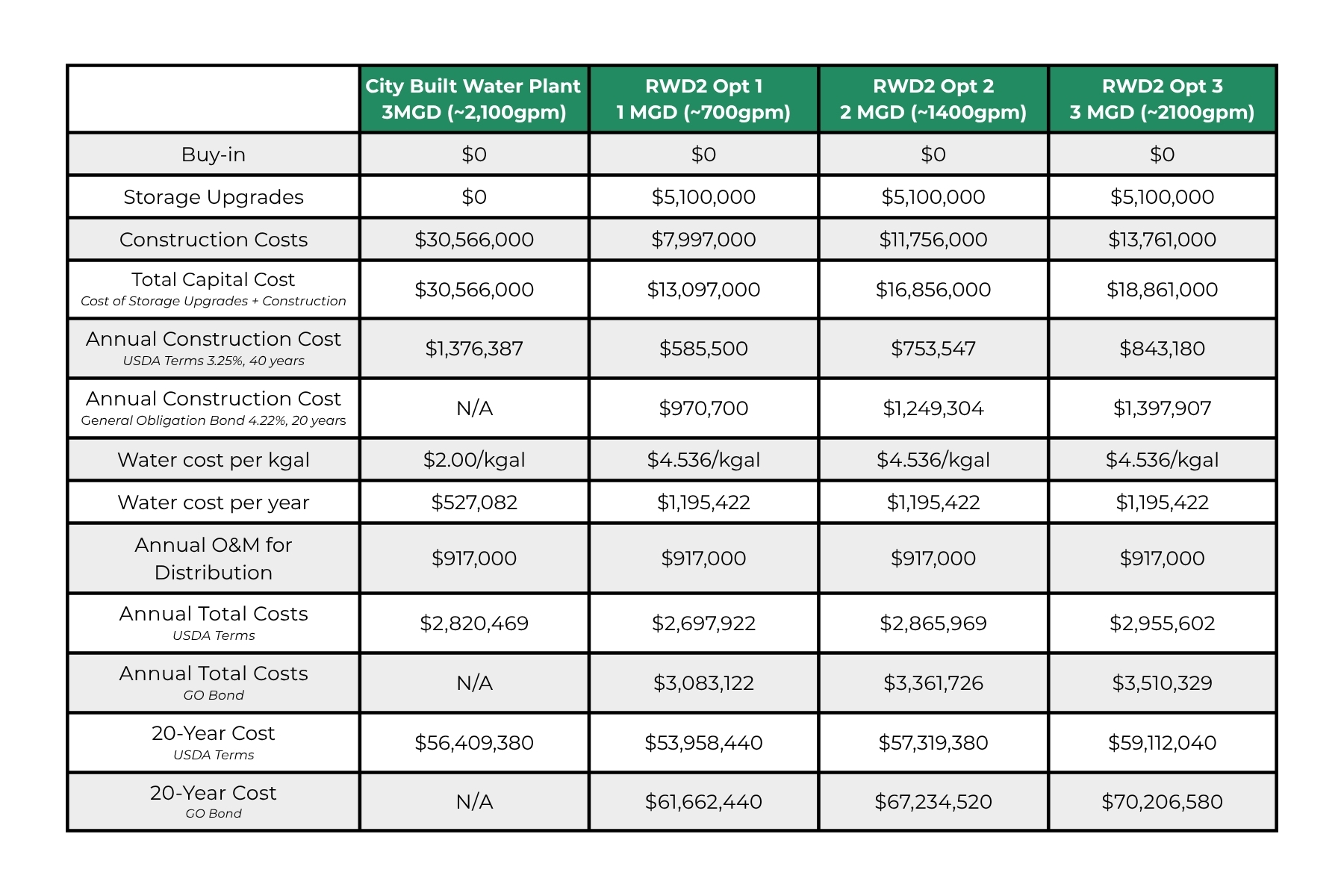
How to Read This Table
The table above compares the estimated costs for different water supply options. Here’s what each label means:
- Buy-In: RWD2 has indicated there will be no required buy-in to Hillsdale at the water rate given.
- Storage Upgrades: Additional storage capacity is needed for any RWD2 connection. These costs were provided by RWD2 and are already part of the new plant design.
- Construction Costs: Based on the USDA Letter of Conditions for the water plant and RWD2’s cost estimates for transmission mains.
- Total Capital Costs: Combines construction and storage upgrade costs.
- Annual Construction Cost: This is the yearly payment, with interest, for each total capital cost over 40 years at 3.25% interest (USDA funding terms). There is no guarantee that a RWD2 connection could be funded at these favorable terms so a second option has been included at a recently received general operating bond term of 4.22% over 20 years for financing the RWD 2 capital costs. A number for building a new water plant under these terms is not provided because general obligation bond funding would only be used if the City were connecting to RWD 2 or another wholesale provider.
- Water Cost per kgal: The cost to produce or purchase 1,000 gallons of water.
- Water Cost per Year: Calculated using Osawatomie’s 2023 total treated volume of 263,541,000 gallons.
- Annual O&M: Annual operations and maintenance for the City’s distribution system—this remains constant across all options.
- Annual Total Costs: Sum of construction, water, and O&M costs.
- 20-Year Life Cycle Cost: Annual cost projected over 20 years for both funding options.
Why the City Cannot Simply Switch Plans
Some residents have asked whether the City could redirect its USDA funding toward a different project, such as connecting to RWD 2 instead of building a new treatment plant. While technically possible, doing so would effectively reset the entire federal approval process. The city has been advised by our grant administrator that a change of this magnitude would require: a new Preliminary Engineering Report (PER) with an updated engineer’s recommendation and financial analysis, a new environmental review under USDA’s process, and a revised USDA review and determination of project eligibility and cost-benefit justification. Each of those steps would take months to complete, with no guarantee of approval. The existing funding commitment could expire before that process concluded. The last time the City of Osawatomie embarked on this process it took two years from application to receiving the letter of conditions awarding the funding. The City would also forfeit the design work already completed and potentially delay progress for years.
The Bottom Line
After years of study, planning, and analysis, the conclusion remains clear: Building a new 3 MGD water treatment plant is the most cost-effective and resilient long-term solution for Osawatomie.
The City remains committed to working with regional partners like RWD 2 while maintaining local control of its water future, ensuring that Osawatomie’s residents, businesses, and future generations have a safe, sustainable, and affordable water supply.
To learn more about our Water Plant Project, please visit the project's home page.

| Attachment | Size |
|---|---|
 Water Plant and RWD 2 Cost Comparisons Water Plant and RWD 2 Cost Comparisons | 598.16 KB |